I worked at the Village Voice as a staff writer and copy editor for many years in the 1990s. My time there allowed me to develop my writing “voice” and investigative interests. I shared space with many of its legendary writers and editors, and was one of the alternative weekly’s few Nuyorican/Latinx writers. in 1995 I was promoted to staff writer by Karen Durbin, one of the only (I actually can’t remember any other) women editors in chief. While most journalists are encouraged to focus on a particular beat, and hard news is separated from arts criticism, I wrote about both politics and the arts, something that my focus on my ethno-racial identity allowed me to do. This is an archive of my work there.
Under the Guns: Navy Threatens Puerto Rican Squatter
I went to the NAHJ convention in San Juan in 1989 and hung around with some people from the Miami Herald and some independentista lawyers. After the panels and a night out to see El Gran Combo, I headed (with an LA Times photographer) out to Vieques on the ferry from Fajardo. I found the seeds of a movement that would finally drive out the Navy 10 years later.
Left Turn on 137th St: Is Washington Heights Incubating a New Latino Politics?
In this piece I take a look at various centers of Latino activism in New York centered around the movement against police misconduct in several communities. It crystallizes a moment when Puerto Rican and Dominican activists were focusing on similar goals, and features interviews with various leaders. I was excited when it was published because it was featured on that morning’s “In the Papers” segment on NY1.
Rock Is Dead and Living in Mexico
The Voice’s Rock and Roll Quarterly had quite a budget, driven by music-oriented advertising, affording me a trip to LA and Mexico City to investigate this new phenomenon called Rock en Español. It was a rare opportunity to witness the peak of a genre that embodied a visceral reaction to the onset of NAFTA, as well as a protest against the social conformity imposed by the infamous PRI. I probably never had as much fun since.
Brown-out: Searching for the Missing Latinos in the Media
It’s almost 30 years later and it’s almost the same story, although I suppose things are a little better now. The major change has been that alternative media, niche websites, and blogs/social media have allowed Latinos to have an increased presence. This piece features interviews with María Hinojosa, Elaine Rivera, Felipe Luciano, and others. This was actually a cover story.
Freddy’s Dead: Latinos Call for an End to Brutality After the Pereira Killing
This was an earlier story I did about the tragic death in police custody of a young man named Federico Pereira. It turns out Freddy’s mom married salsa star Tito Nieves and moved him out to Jersey–Freddy missed his boys back in Queens and ran into trouble when he went back home to hang out. The saddest part was interviewing his girlfriend, who was still in mourning.
Rockin’ La Casa: Reflections on the New Latin Groove
Perhaps an overambitious attempt to tie several different strands of “Latin” music in New York together. At the time (the mid-’90s), you had r&b-influenced salsa, nascent merenhouse/rap, lots of Cuban music blowing into town, as well as a bossa nova fad and of course David Byrne’s Luaka Bop label almost breaking what became Latin alternative.
Amis and Envy: Review of The Information by Martin Amis
When I was promoted to staff writer at The Voice, they decided I should be able to weigh in on mainstream stuff like the latest novel by big-time English writer Martin Amis. I actually kind of like his style and had enjoyed some of his books, but here I had my own take about his seeming bitterness that they were awarding the Booker Prize consistently to writers of color.
Circle of Fire: Santería Comes Out
I think I may have taken on more than I could handle with this story, and at times my observations can come off as superficial, if not naive. Despite my misgivings, re-reading this one surprised me with how much I tried to feel this one out viscerally, and what I got out of myself in doing so. The subject, Afro-Caribbean Santería, is probably not best spoken about casually, but i hope my real attempts at getting inside stand the test of time.
Joseph B. Vasquez, 1962-1995
For a while I was pretty good friends with Joe–I’d profiled him for the Voice when his first major film Hanging With the Homeboys came out. I think we met in that fake Latin@ restaurant that used to be on First Avenue and Houston. He immediately invited me to play basketball on Saturdays with John Leguizamo. He was in love with a lady from the Bronx who had a trendy shop on Houston near Broadway, and I thought he had good taste. He got a terrible scar on his face when he got pissed at a guy bumming change at the 110th St. station on the 6 line. He learned to make films at City College, not NYU or UCLA, and he was proud of that, and being from the Bronx. I felt terrible when he died.
Alfonso Cuarón’s Mexican Pie
This piece was actually published in 2002, a feature on Alfonso Cuarón’s Y tu mamá también. We did the interview at the Mercer Hotel with co-stars Gael García Bernal and Diego Luna in tow. Now that Cuarón has won big-time Oscars, it’s worth looking at where he was 12 years ago, aspiring to do mainstream movies and reveling in having escaped the PRI-dominated Mexican film establishment. Unfortunately Maribel Verdú was not with them for this interview.
A Festival Latino
Speaking of Verdú, here’s my first dispatch from a three-year run of covering the Puerto Rican International Film Festival, published in 1991. Although not as cool as another festival that was happening in Puerto Rico those days, this one afforded me the chance to see new releases like Reservoir Dogs, which I saw on a tiny Hi8 viewer in the festival director’s suite at the Sands, to long-forgotten Latin American gems like Confesión a Laura. Plus i got to hang out with the irrepressible Verdú, who flashed her tetas at me poolside–resentful of Puerto Rico’s prohibition on topless sunbathing–before she was whisked away by her handlers, never to be seen again (by me, at least).
Junot What?
Back in ’96, when he was first getting “discovered” Junot was partial to big geeky aviators and striped polos. He interested me because of the multiple identities he expressed, firmly based in a lower-middle-class Nuyo-Caribeño experience. In this piece you get an idea of his deliberate working pace–he mentions working on a “novel” called The Cheater’s Guide to Love, the strongest story in his most recent collection, published in 2012.
King of New York
I’ll never forget hanging out with King Tone in the process of putting together this fascinating feature story on the Latin Kings
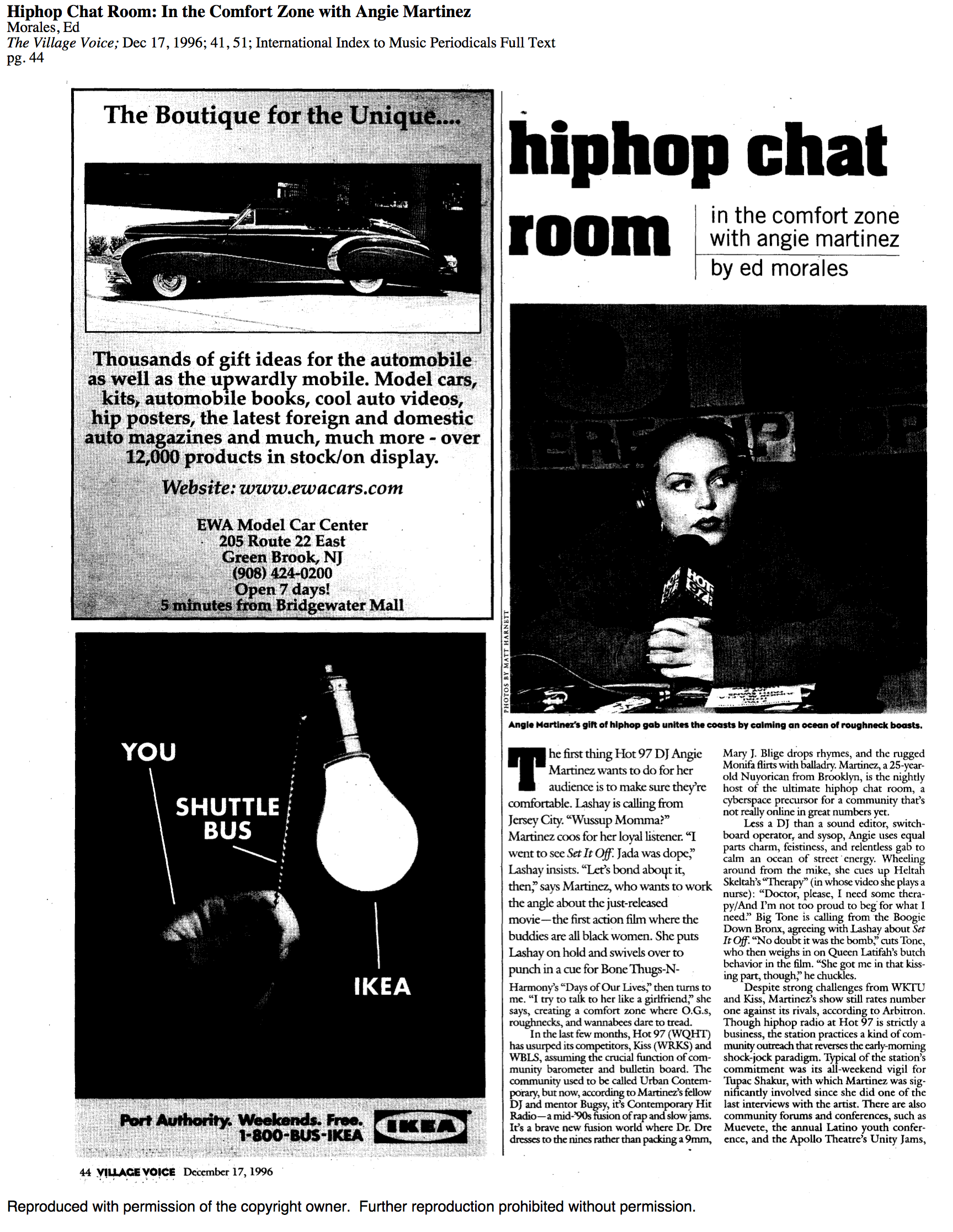
Hip Hop Chat Room
I’m not sure…maybe Vibe was first, but this is one of the first stories about DJ Angie Martinez, a significant figure in 1990s New York hiphop.
Viva Las Vegas
Based on gonzo journalist Hunter S. Thompson’s influential book, the Fear and Loathing in Las Vegas movie was not particularly memorable. I interviewed rising star Benicio Del Toro, who played the character based on Oscar “Zeta” Acosta.
Injustice in the Bronx
The death of Anthony Báez after a violent encounter with Officer Francis Livoti was one of the highest-profile police brutality cases in New York during the 1990s. I wrote several articles about that movement, led by former Young Lord Richie Pérez, who passed away in the early 2000s.
El Santero de Oz
In the early 1990s I traveled to Chicago to do a feature on White Sox shortstop Ozzie Guillén. He was elusive at first but finally spoke with me through the intervention of legendary Spanish language sports broadcaster Juan Vené, who I met in the press box at Comiskey Park.
No Apologies
I reviewed Rage Against the Machine’s album Evil Empire in 1996, as woke as woke gets.
Ready for Freddy?
In the late 90s there was a narrative that there should be a Latinx mayor, and Bronx Borough President Freddy Ferrer was the most likely option. Of course, many were skeptical (even Hispanic Federation/Mirram Group mogul Luis Miranda, who called Freddy a “perfumado” in this piece).
Roots Remix
In 1997, I reviewed Kenny “Dope” González and Little Louie Vega’s Nuyorican Soul album. It felt like a celebration of a new Latin groove moment. Still an overlooked, under-rated classic.
Rumbling in the Bronx
For this feature about Spike Lee’s Summer of Sam I got to interview Spike at CBGB’s, sit in a diner in Throg’s Neck with John Leguizamo, and hang in a trailer with then-unknown Adrien Brody, who happened to be legendary Voice photographer Sylvia Plachy’s son. I’ll never forget how she teared up while they were filming the scene when Brody’s character is beat down in the street, even though it was all fake.
Battle for El Barrio
This is reporting I did about a state assembly race in East Harlem pitting Francisco Díaz and War on Puerto Ricans author Nelson Denis. Sometimes I miss the grind of reporting but, maybe not.
Reigning on the Parade: Giuliani’s “El Macho” Campaign
Writing about Latinx in politics in New York was a little like being a sportswriter. Fortunately I had some experience in locker room interviewing.
 ED MORALES